Who are our online learners?
As you have already learned, there were 5,533 students who took at least one online course at ISU during Fall 2019. However, 2,475 students took all of their courses online. A total of 42% of the distance students are between the ages of 18-30, about half of them are between 31-45, and rest are older than 45. Almost 70% of the fully online students were enrolled in undergraduate courses while the remaining 30% were graduate students. This pattern remains true during the current semester.
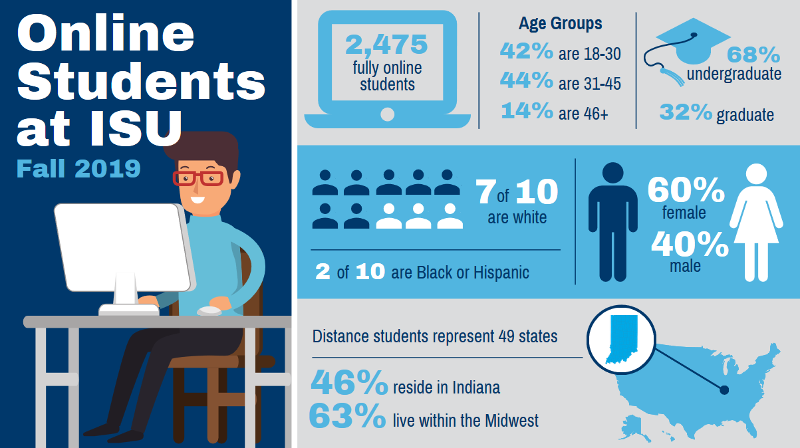
Our institution welcomes both traditional high school students as well as adult learners who represent multiple age ranges. While most online students are undergraduates, a significant number of graduate students attend ISU. Additionally, besides serving black and low-socioeconomic status students, ISU also concentrates efforts to educate Hispanics and international students. In fact, increasing the number of Hispanic students at ISU is part of our strategic goals.
The characteristics of the undergraduate student population is changing over time. Not only do the traits of the youngest students shift with each generation, today's adult learners also represent different needs and learning preferences. Today's learners juggle education with work, immediate family commitments, and aging parent care. Some learners hold multiple jobs, work 24-hr shifts, raise children, possess various work experiences, and use technology at differing levels.
Therefore, adult learners require flexible options to meet their unique needs. Besides, learners with disabilities, international students, and Hispanics each have unique learning inclinations. This lesson describes each of these groups and lists practical tips for you to adjust your instructional methods as necessary to create student success for these online learners. While these online students take at least one online course, they may also take your campus-based courses. Facilitating their growth in either environment is a success for the institution, students, and other stakeholders.
The next few pages of this lesson detail the traits of the three relevant generations (Gen X, Y, and Z) before moving on to Hispanics, international, and lastly disabled population.
Inforgraphics credits is given to Katie Reed
