Hispanic Students
Hispanics/Latinos are one of the fastest growing racial/ethnic groups in postsecondary education. 5 Let's start with distinguishing between Hispanics and Latinos. It is important to know that Hispanics are those who have origins in Spanish-speaking countries regardless of race, whereas Latino, Latina, Latinx people are those who have origins in Latin American countries.
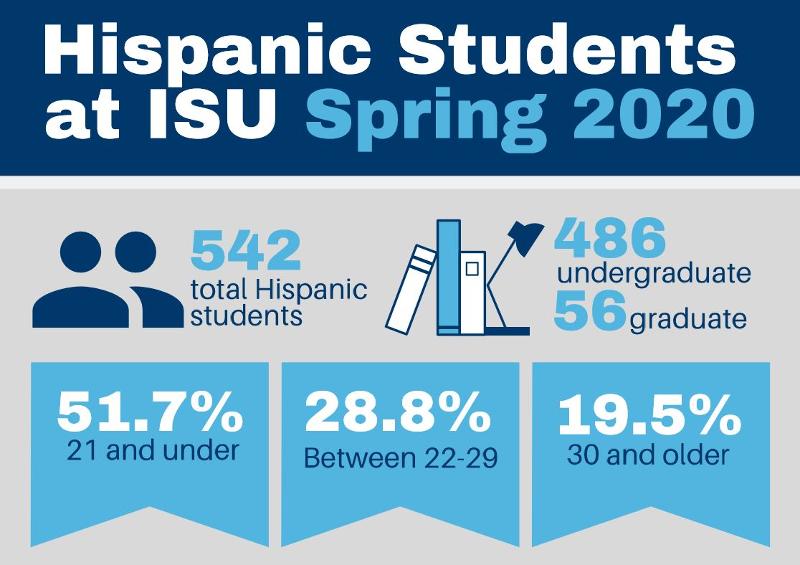
Whether referred to as Mexican-American, Hispanic, or Latinx, these populations are present at ISU. A total of 542 Hispanic students were at ISU during Spring 2020 of whom 486 were undergraduate and rest of them graduate students. As shown on the infographic, 51.7% were students younger than 21 years old, 28.8% were between the age of 22 and 29, and 19.5% were 30 years and older. While about half of them were traditional students, the other half were adult learners. (Data source: ISU Institutional Research).
Traits of Hispanic/Latinx Students
- A majority of Latinx adults work more than 30 hours per week while enrolled as undergraduates
- About one-third of Latina (female) students are also caring for dependent children
- They respect authority figures and work hard
- Males are seen as dominant and strong, females as nurturing and self-sacrificing
- Often, Hispanic students represent low-socioeconomic status and are the first within their families to attend college
- To make ends meet, they often juggle work, school, and family responsibilities as many others
- One cultural value that is of paramount importance in most Hispanic cultures is family commitment
- Hispanic adolescents have a greater inclination to adopt their parents' religious beliefs, lifestyle, and stereotyped sex roles.
- Hispanic male adolescents often become independent from parents earlier than male adolescents of the general U.S. population. 1
Learning Preferences
- Prefer meaningful learning activities based on familiar concepts 2,4
- Desire materials that are linguistically as well as culturally appropriate 2,3
- Wish to connect the knowledge learned in the classroom to the home, community, and professional environment 2
- Facilitate the expansion of their literacy skills and connect it to relevant content 2
- Feel more comfortable and confident about their work 2
- Prefer kinesthetic instructional resources, a high degree of structure, and variety of instructional strategies 1
- Learn through interacting with peers 1,2
Practical Tips
- Incorporate career readiness resources and assignments into the curriculum
- Provide examples, demonstrations, and optional resources that meet their needs; model cognitive learning processes in lectures 2
- Establish a welcoming community through frequent discussions, small group work, and peer-evaluation activities; these will also develop social, academic, and communication skills 2
- Develop group projects where students work with a partner 1
- Decrease their anxiety by encouraging them frequently, reinforce what is possible 2
- Host optional workshops or study sessions online where participants can ask questions
- Implement multiple formative assessments (practice opportunities) to detect potential problems and offer solutions
- Utilize journal reflections that allow them to reflect on their achievements and serve as a platform to express themselves freely and openly
- Use multimedia to deliver content; add closed captioning and transcripts to videos, these will serve as study tools
- If possible, offer learning materials in both English and Spanish
- Develop proficiency in English by providing students with rich language experiences that integrate speaking, listening, reading, and writing 2
- Engage students in research opportunities to increase their interest in a specific field
- Recognize that someone with an accent may speak multiple languages and can articulate their thoughts more in writing than verbally 1
- You can address self-image problems of Hispanic-American students that may result from a rejection of their ethnicity by using interventions that celebrate cultural diversity1
- You may emphasize the learning style strengths of each individual and match instructional resources and methods to individual learning style preferences (by following universal design principles)1
Here is the next quiz!

1 Griggs, S., & Dunn, R. (1995). Hispanic-American students and learning styles. Emergency Librarian, 23(2), 11.
2 Padron, Y. N., Waxman, H. C., & Rivera, H. H. (2002). Educating hispanic students: Effective instructional practices. Practitioner Brief #5. University of California: Center for Research on Education, Diversity & Excellence. Santa Cruz, CA. Retrieved from http://citeseerx.ist.psu.edu/viewdoc/download?doi=10.1.1.484.461&rep=rep1&type=pdf
3 Arbelo, F., Martin, K., & Frigerio, A. (2019). Hispanic students and online learning: Factors of success. HETS Online Journal, 9(2)
4 Jones, I. S., & Blankenship, D. (2018). Learning styles of hispanic students. Journal of Business & Educational Leadership, 8(1), 124–133.
5 Excellencia in Education. (2018). What works for latino students in higher education. Retrieved from https://www.edexcelencia.org/2018-What-Works-for-Latino-Student-Success-in-Higher-Education
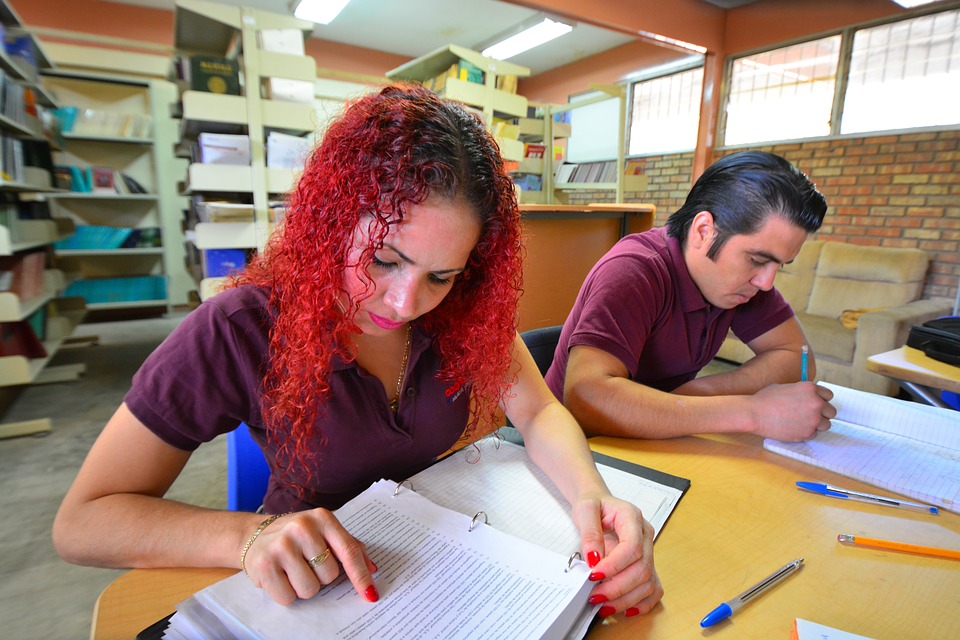
Image: "Hispanic Students" by Ernesto Eslava is licensed under Pixabay License
