International Students
International students make a challenging transition when arriving at ISU just like college freshmen. Their circumstances may vary greatly: some may be by themselves without family and friends, some may live very far away from someone or anything familiar, while others may have an entire cultural community and family to encourage them. They can experience a culture shock upon arrival, and the adaptation and language challenges can demand a great deal of energy. 2
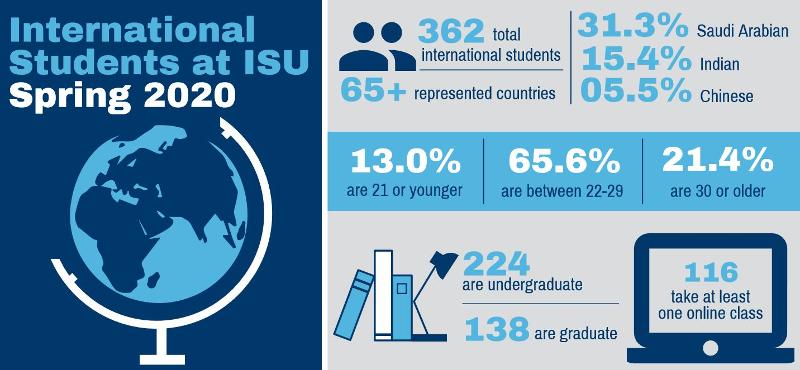
According to Institutional Research, ISU had 362 international students on campus during Spring 2020. Of these students, 138 were enrolled in graduate and 195 in undergraduate programs. A total of 116 international students took minimum one online class. Their situation is quite unique because international students must take most of their classes on campus in a face-to-face classroom environment to meet their Visa requirements, so the number of online courses each student is allowed to take online is limited. Keep in mind that International students represent added value to your courses and other students because they can share a multicultural perspective of the world without having to travel to all those destinations. 4
Traits of International Students
- Some receive family support (both economic and psychological) while others are completely alone
- Many are unable to work in this country because of Visa restrictions prohibit it 3
- Academically, they arrive with positive and confident personal expectations of success
- The majority of them expect a rewarding and enriching experience
- International students perceive career development and job preparation as their most important needs
- Many of them are concerned about their English-speaking and writing skills
- They are multilingual; some speak at least one while others several languages
- A feeling of solitude is also a factor that hinders their online learning

Learning Preferences
- Let students think and reflect before you call on them for answers1
- May experience high levels of isolation in both traditional and online classes, online courses make them feel more isolated5
- At the same time, students can also experience less anxiety in online classes because they don't have to worry about speaking in front of their classmates
- They can work on assignments at their own pace
- Prefer seeing examples
- May not be familiar with the American academic writing standards and citation requirements; need assistance
- May review their responses before posting comments on the discussion forums5
Please watch this brief video that points out some more of the main traits, needs, and preferences of the international student population.
Practical Tips
- Learn the names of international students so that they feel comfortable.
- Students may have difficulty articulating their thoughts and have an accent, but that does not mean that they cannot produce high-quality work.1
- Recognize that someone with an accent may speak multiple languages can articulate their thoughts more in writing than verbally.1
- Avoid interpreting their low engagement as disengagement because they may need to absorb the information before they feel confident to speak up.
- When referencing American culture clarify the reference for international students. Ask international students to provide their own cultural examples to exchange information across multiple cultures.
- Assigns students to groups and take on different roles so that international students are not picked last by their peers due to their language challenges.1
- Avoid saying, "Your English is already really good." This puts the emphasis on the language ability of the students, rather than their knowledge of content and assignment performance.
- Using Universal Design Principles, you may promote language learning and provide a closed caption during presentations, or you may record lectures and share with the entire class.
- Use language carefully and clarify the acronyms to avoid misunderstandings.
Here are some additional tips:
- Create a well-structured course/unit.
- Provide audio and visual supplemental materials to help students understand concepts and improve their English listening and speaking skills. A glossary is also a useful resource.
- Use both synchronous and asynchronous communication tools.
- Implement multiple formative assessments (practice opportunities) to detect potential problems and offer solutions.
- You can use cultural differences for instruction and turn them into teachable moments. International students can provide examples for comparison and raise awareness about how open communication can bridge differences. Be sure to clarify those references for international students when using a reference to American pop culture.1
- Cultural disparities should not hamper international students ' academic success. Learning in a diverse classroom prepares students both at home and abroad to become global citizens. Online classrooms can overcome cultural boundaries and bring all the students together with the appropriate course design.5
- Communicate classroom expectation and policies clearly.6
- Encourage students to make use of office hours.6
- Discuss academic integrity because each country may have different levels of expectations.6
- Make course materials available in multisensory formats.6
- Provide clear guidelines for assignment requirements.6
- Incorporate opportunities for collaborative learning, where international students are working in separate groups together with other nationalities.6
Let's see what you take away from this section.

1 Baier, Stefanie T. (2020, February 17). Dos and don'ts when working with international students in the classroom. Retrieved from https://www.facultyfocus.com/articles/effective-classroom-management/dos-and-donts-when-working-with-international-students/
2 Baier, Stefanie Theresia. (2005). International students: Culture shock and adaptation to the U.S. culture. Exceptional Children 26(5):278-79.
3 Carter, Robert T. & Sedlacek, William E. & Maryland Univ., College Park. Counseling Center. (1985). Needs and characteristics of undergraduate international students. Research Report #1-86.
4 Rivas, J., Hale, K., & Burke, M. G. (2019). Seeking a sense of belonging: Social and cultural integration of international students with american college students. Journal of International Students, 9(2), 687-704.
5 Kobayashi, Michiko PhD. (2015). Supporting international students online.Retrieved from https://www.facultyfocus.com/articles/online-education/supporting-international-students-online
6 Elturki, Eman. (2018, June 29). Teaching international students: Six ways to smooth the transition. Faculty Focus.Retrieved from https://www.facultyfocus.com/articles/effective-classroom-management/teaching-international-students-six-ways-to-smooth-the-transition/.
Image: "International Students at ISU" by Ashima Sitaula is used with permission
